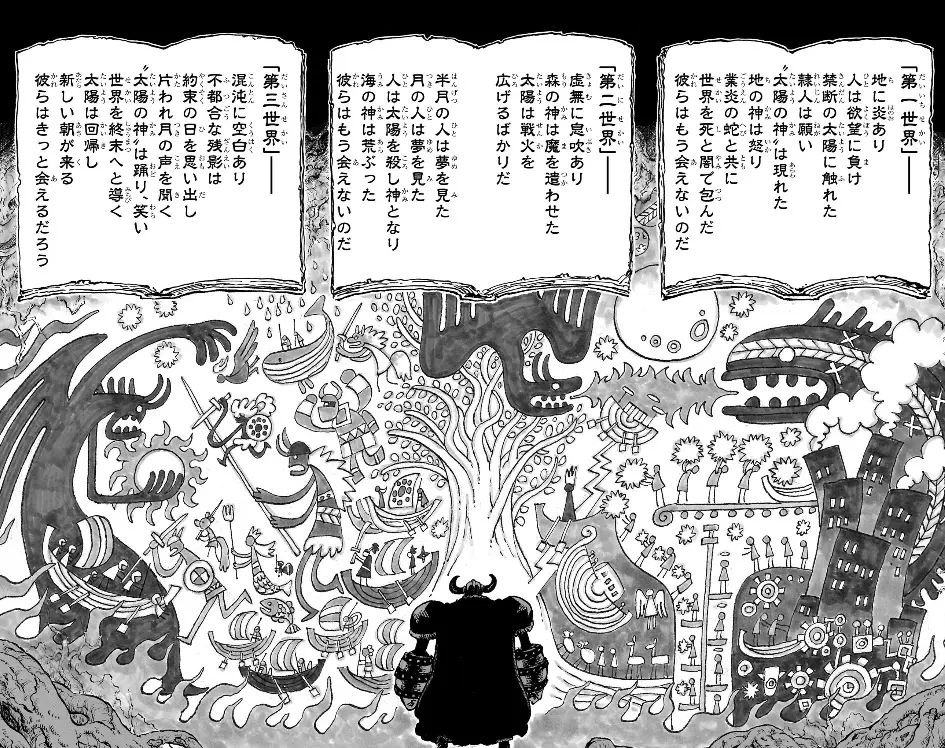
This mural might not depict the past…
It could be showing the FINAL WAR of One Piece.
A battle where the Sun God (Luffy) rises against the demon (Imu)—
a conflict so massive it engulfs the entire world.
Then what about the other elements scattered across the mural?
In this article, we’ll break down what this mural truly represents—
and how it connects to the Harley (Sacred Text) and the future of the story itself.
The Mural Depicts the Dreams of the “Moon People”
The mural is carved into what appears to be petrified tree bark, and due to its historical significance, it has been designated as a cultural heritage artifact of Elbaf.
It is located in the second layer of Elbaf, known as the “Sun World.”
It is estimated to have been created around 900 to 800 years ago, placing it right within the era of the Void Century.
According to Ripley, it was originally nothing more than “children’s graffiti,” and what it depicts are essentially “children’s dreams.”
The mural depicts various races—including the Giants—uniting to fight against a demon.
However, according to the history known by Ripley and others, while there were conflicts between different races, there was never any real interaction or cooperation among them.
Because of this, it’s believed that the mural represents a child’s dream—an idealized vision of “what if everyone came together like this?”
There’s little doubt that what’s depicted is a “dream.”
However, the idea that it was created by children may not be entirely accurate.
So then—who exactly was responsible for drawing that mural?
The key to that mystery may lie in the “moon.”
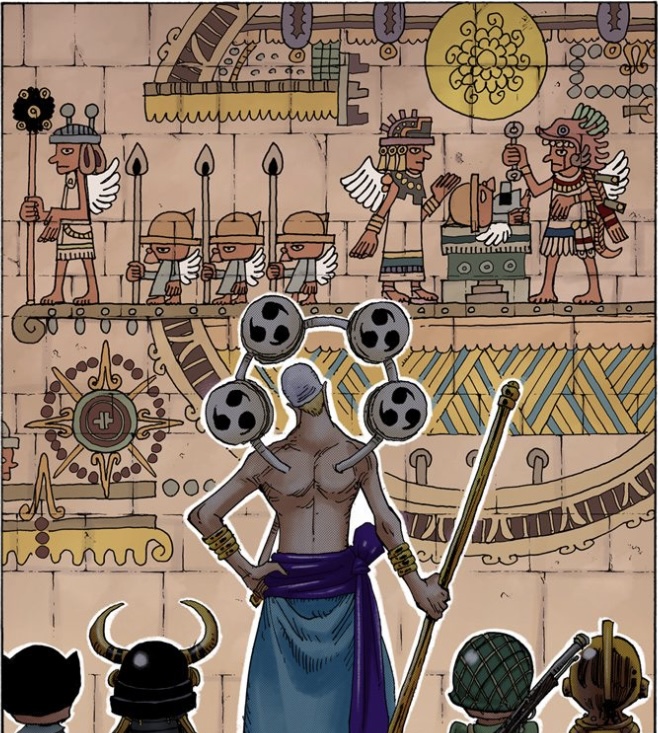
There are also murals on the moon that Enel traveled to, and they bear a striking resemblance to the mural in Elbaf.
More importantly, the very culture of preserving events—history—through murals appears to be a shared trait between the two.
The people of the moon are said to have come to the “Blue Planet.”
So perhaps the mural preserved in Elbaf was actually drawn by the people of the moon, making it a reflection of their dream.
In other words, rather than being the work of Giant children from Elbaf, it may represent what the moon people themselves wished for—an ideal world they longed to see become reality.
In Elbaf, there also remains a research facility that dates back over 3,000 years (Chapter 1144).
It is no longer in use, and its presence feels undeniably out of place within Elbaf.
Could this facility have been built by the highly advanced kingdom—the so-called “Great Kingdom”—that is said to have been destroyed during the Void Century?
The people of the moon are believed to have arrived on the Blue Planet more than 3,000 years ago.
It’s possible that they were allowed to establish a research facility in Elbaf during that time.
So why would the “Great Kingdom” choose to build a research facility in Elbaf rather than within its own territory?
One possible explanation is Elbaf’s uniquely perfect climate, which may have made it an ideal environment for developing and testing a wide range of technologies (Chapter 1133).z
Joy Boy was born in the “Great Kingdom.”
During the Void Century, he is said to have sent an apology letter to the Mermaid Princess of Fish-Man Island.
He also made a promise to continue watching over the giant ship Noah.

On Fish-Man Island, there was a dream once pursued by the ancestors of King Neptune—one that ultimately ended in failure.
There are hints that the ship Noah was tied to that very dream.
That dream was the same as Queen Otohime’s wish: for her people to move to the surface and coexist with humans.
It was the dream of Fish-Man Island… and perhaps also the dream of Joy Boy.
Could it be that the “Great Kingdom” itself envisioned a world where all races of this planet would stand united?
Perhaps that is the dream they chose to leave behind—etched into the mural of Elbaf.
The Mural and the Harley
n Chapter 1138, the text of the Harley (Sacred Text) was presented alongside the mural.
As Franky gazes at the mural, Robin can be heard reading from the Harley in the background at the library—creating a scene where the two are clearly intertwined.
So what exactly is the connection between the mural and the Harley?
To begin with, what is it that the mural actually depicts—
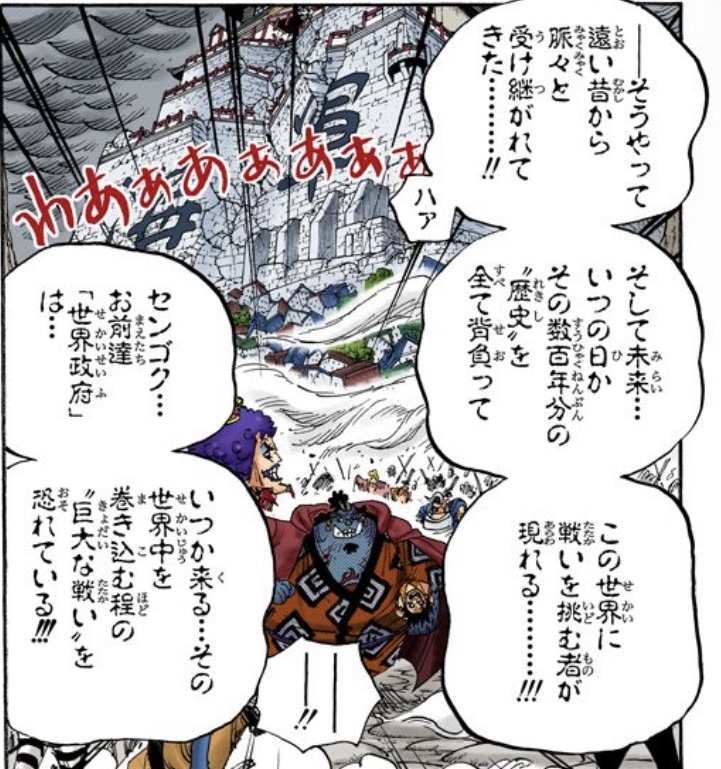
It likely represents a “massive war that will engulf the entire world.”
In other words, this is not a depiction of the past—but of the future.
What we’re seeing may be the moment when the Sun God (Luffy) rises to challenge the demon (Imu).
Although the mural was created during the Void Century, it likely does not depict events from that time.
This is because, as Ripley herself states, there was no such interaction or cooperation between different races back then—nothing like what is shown in the mural.
In other words, the mural does not correspond to the entirety of the Harley’s account.
Rather, it appears to capture a fragment of the story of the “Third World”—a record of events yet to come.
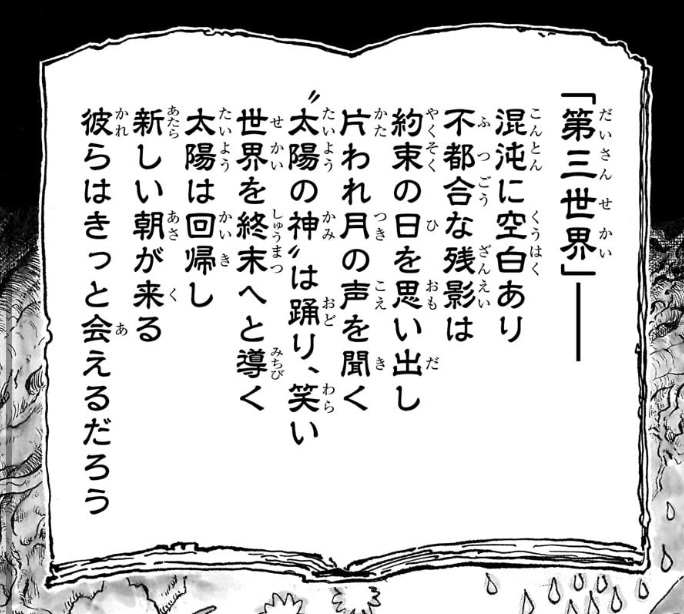
In chaos, there is a void—
An inconvenient remnant lingers.
Remember the promised day,
And listen to the voice of the half-moon.
The Sun God dances, and laughs,
Guiding the world toward its end.
The sun returns,
And a new dawn arrives.
The mural specifically depicts the line:
“The Sun God dances and laughs, guiding the world toward its end.”
That moment represents the very battle meant to lead the world into its dawn—
the same “massive war that will engulf the entire world” that Whitebeard spoke of.
If, through that battle, “the sun returns and a new dawn arrives,”
then the world will finally witness its long-awaited dawn.
It would mark the arrival of a world where all races can live together without discrimination—
a world that truly embraces everyone in existence.
The first half of the “Third World” likely details the existence of the Void Century, as well as the events leading up to the moment when someone finally discovers the One Piece.
What the Mural Depicts
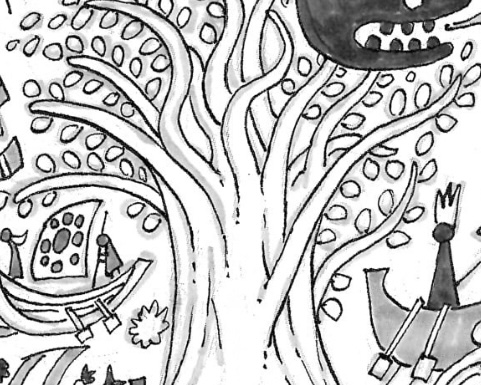
Sunlight Tree Eve
The massive tree depicted at the center of the mural is likely the Sunlight Tree Eve.
It may represent the very stage of the “great war”—suggesting that the battle will erupt at the center of the world itself.
That said, it’s still unclear whether the Holy Land Mary Geoise will actually serve as the battleground.
If the Sunlight Tree Eve, of which only the roots have been shown so far, were to fully reveal itself—
there’s no telling what would happen to Mary Geoise.
The Sun and the Moon
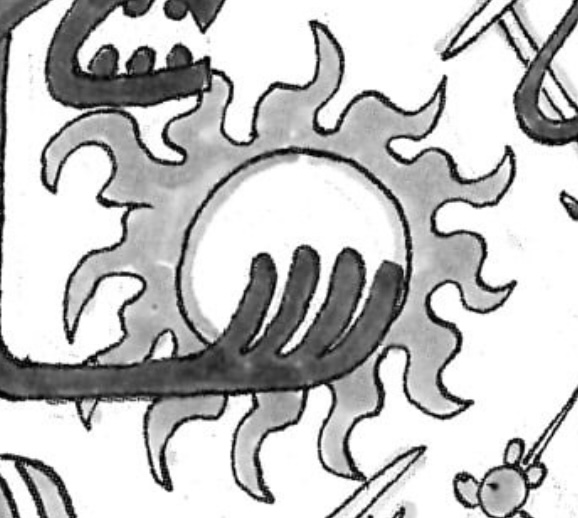
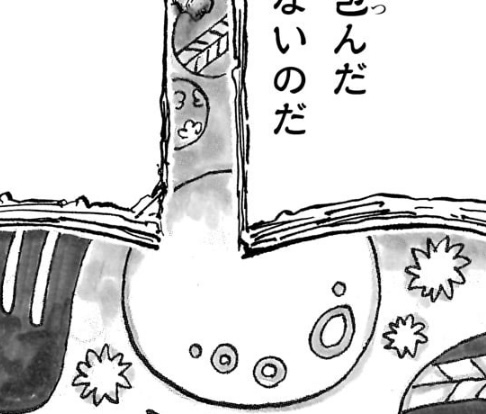
On the left side of the mural, the demon appears to be holding the sun, while the moon is depicted in the upper right.
The objective of the battle, then, may be to take the sun back from the demon—and by doing so, bring about the dawn of the world.
The sun here likely does not represent the “ancient energy.”
Instead, that energy is probably symbolized by the jagged spheres held by people elsewhere in the mural.
As for the moon shown on the right side, it may indicate that the ships and structures beneath it are products of lunar technology.
In that sense, it could point to the homeland of the people of the “Great Kingdom.”
If you look closely, there appear to be two stars above the large moon as well.
This likely ties into the planetary model shown in Ohara’s library (Chapter 392), which suggests that the Blue Planetmay have more than just a single moon orbiting it.
Imu and the Five Elders
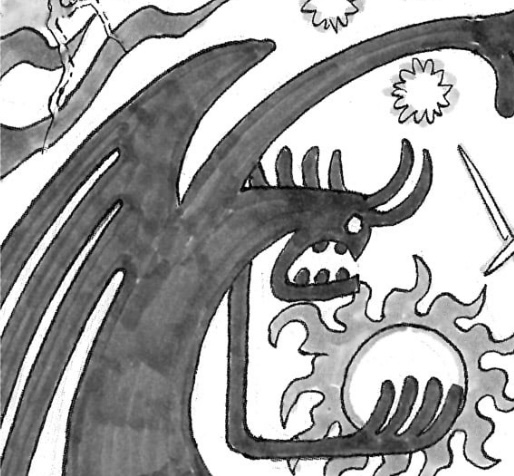
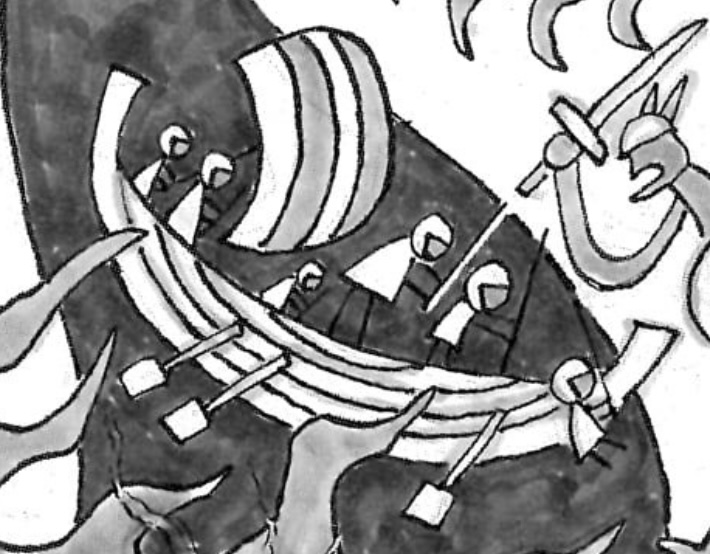
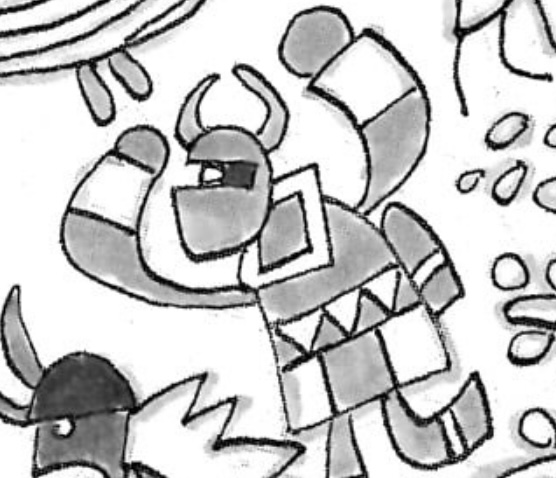
The massive demon depicted on the far left of the mural is likely Imu, while the figures aboard the ship at its feet are thought to be the Five Elders.
If so, they would represent the very enemies that must be defeated in the “great war.”
There are five individuals on the ship, with one seemingly falling off.This could symbolize how Saint Jaygarcia Saturn was purged, and Saint Figarland Garling was newly appointed in his place.
The Two Kings
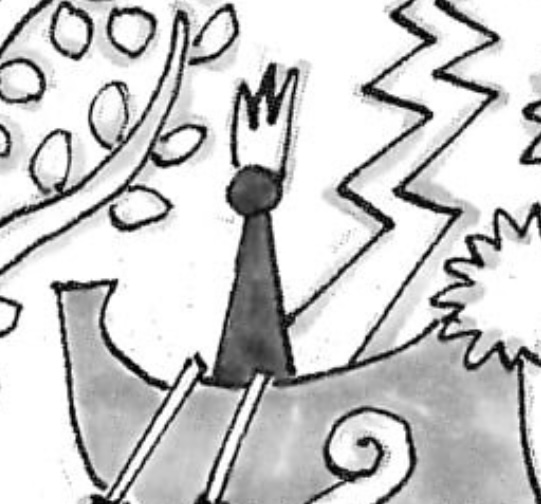
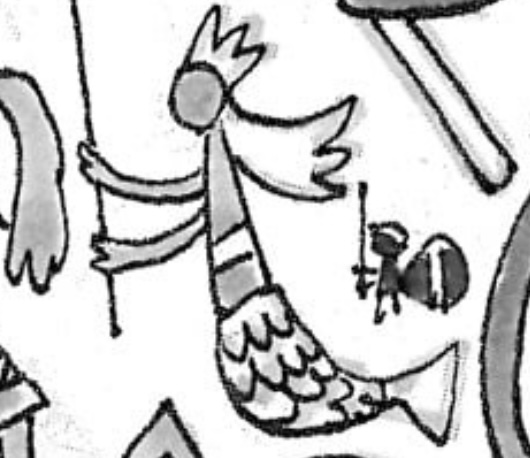
In the mural, there are two figures depicted wearing crowns.This likely represents the “two kings.”
This ties back to the words spoken by the Sea Kings, which were overheard by Roger and Kozuki Oden (Chapter 968).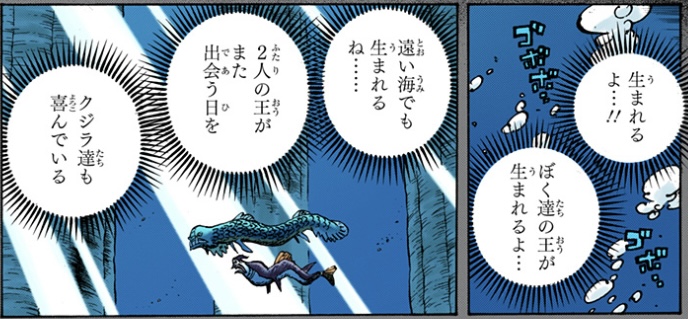
This point is extremely important—
The king standing at the bow of the ship likely overlaps with what Queen Otohime spoke about in Chapter 626:
“the one who will guide Princess Shirahoshi correctly.”
And I believe that both of these roles will ultimately be carried by Luffy.
I believe the “two kings” are Luffy and Princess Shirahoshi.
Therefore, in the context of the mural, the figure corresponding to Luffy is represented by two roles:the “king at the bow” and the “Sun God.”
It’s not one or the other—both are Luffy.
As for the mermaid wearing the other crown, it likely carries a dual meaning as well:both Princess Shirahoshi as an individual, and the Merfolk as a race.
Again, it’s not either/or—it represents both Shirahoshi herself and her people.The Sun God and the Various Races
The Sun God
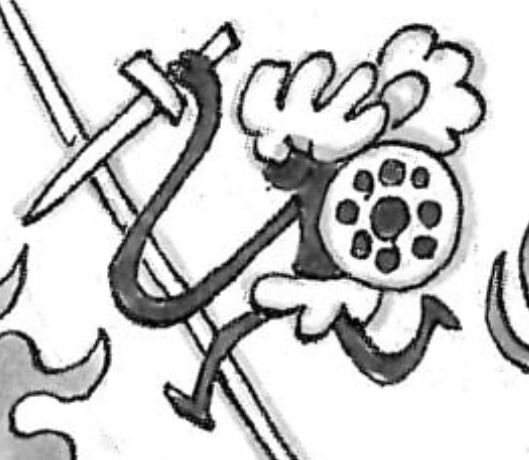
Merfolk
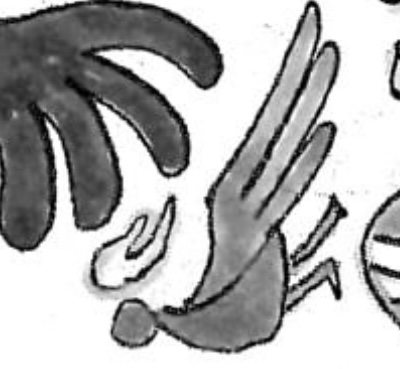
Lunarians
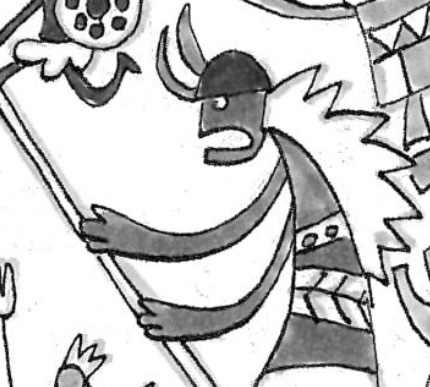
Ancient Giants
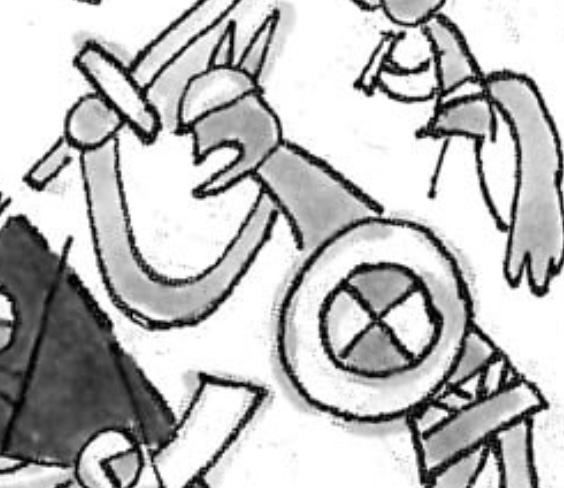
Giants
Tontatta (Dwarves)
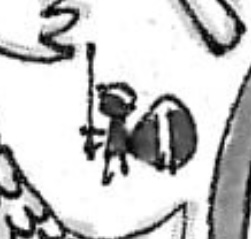
Minks
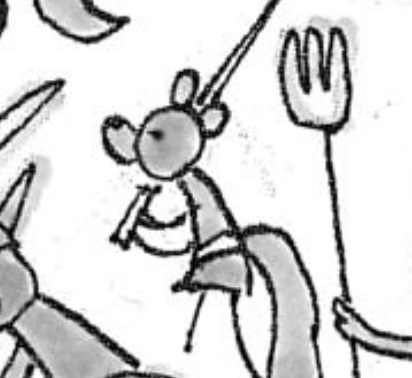
Minks (Sulong Form)
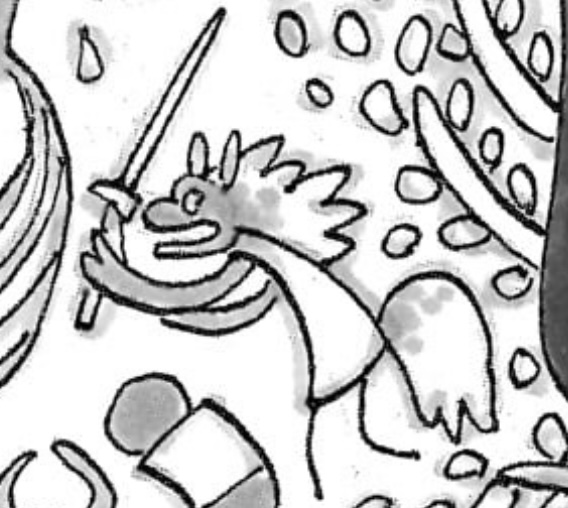
Fish-Men
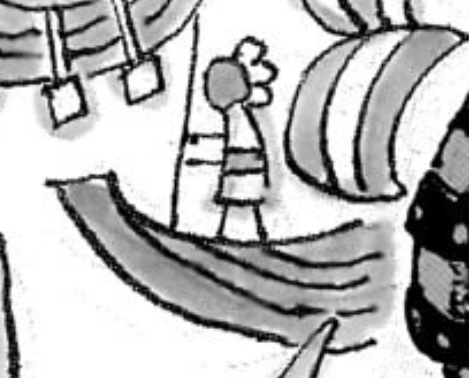
Longarm Tribe
Emet (The Iron Giant)
At the core of this mural is the idea that the Sun God Nika (the Warrior of Liberation) leads various races in a united effort to challenge the demon (Imu).
The liberation of all races—the idea of freedom for everyone—is what truly matters here.
What they seek is the “dawn.”
And the demon (Imu), who holds the sun, is the one preventing that unity from being realized.
So what exactly happens when the One Piece is found?
Depending on that, even the meaning of the “sun” itself may change.
Another key detail is the inclusion of both the Ancient Giants and the Giants.
This is important.
The Ancient Giants likely represent Elbaf, while the Giants symbolize those outside of Elbaf.
There is mutual prejudice between Elbaf and other Giants—labels like “tainted blood” or “barbaric.”
And yet, in the mural, they are depicted fighting side by side.
Perhaps that, too, represents a dreamed-of world.
The Minks are also shown twice—those who have transformed into Sulong (Moon Lion) and those who have not.
This likely carries meaning as well, particularly with the mysterious figure depicted beside the Sulong form—but we’ll get to that later.
As for the Fish-Men, they are identified by their fins.
There are also figures that are harder to clearly distinguish, but it’s possible that each person shown aboard the ships represents a different race—
with humans being one of them as well.
The Nations Providing Support from the Rear
Alabasta Kingdom
Wano Country
Mokomo Dukedom
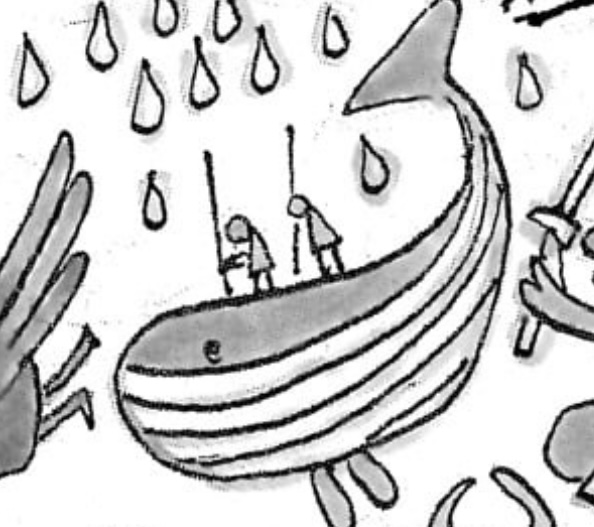
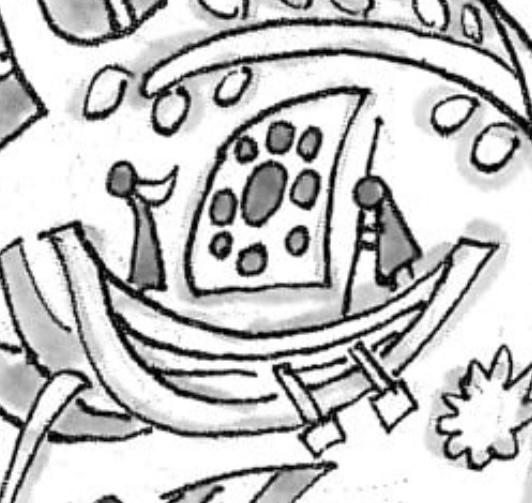
The symbol depicted on the sail appears to be a national flag, and the ship carrying a woman likely represents the Alabasta Kingdom.
That woman is probably Vivi, and she may come to embody the role of a reincarnation of Queen Lili.
Queen Nefertari Lili was one of the twenty kings during the Void Century.
However, it was later revealed that she carried the name “D.”, leaving the circumstances behind that revelation shrouded in mystery.
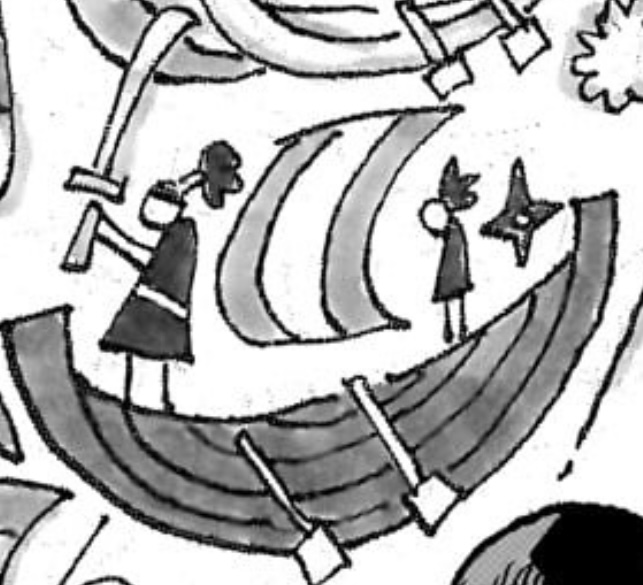
The samurai and ninja likely represent Wano Country.
The whale appears to reference the great tree on Zou, symbolizing the Mokomo Dukedom, while the rain likely represents the “eruption rain”—Zunesha’s massive water spray.
Placing the Sulong form right beside it may serve as an additional hint tying these elements together.The Four Ships and the Ancient Weapons
Noah
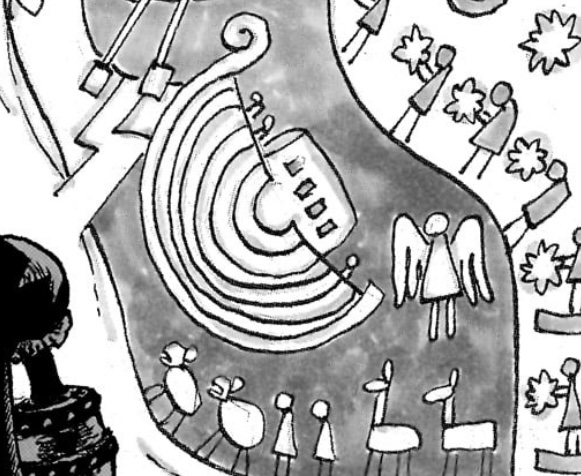
Maxim
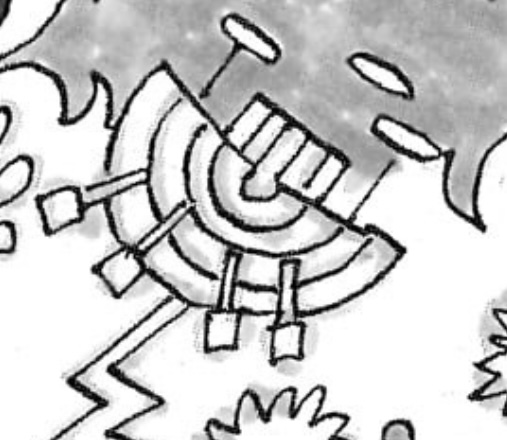
Uranus
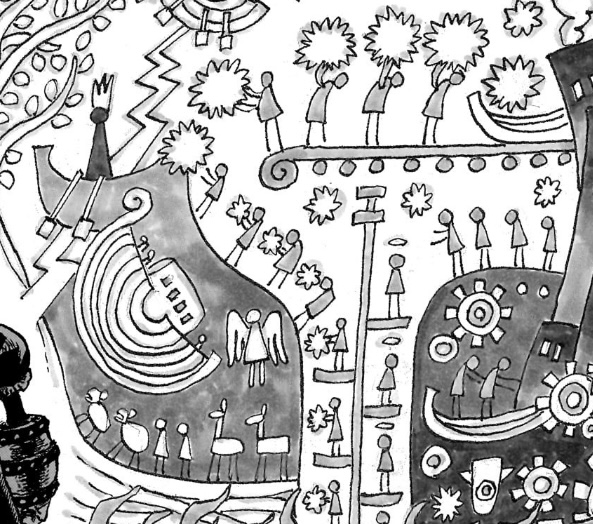
Pluton
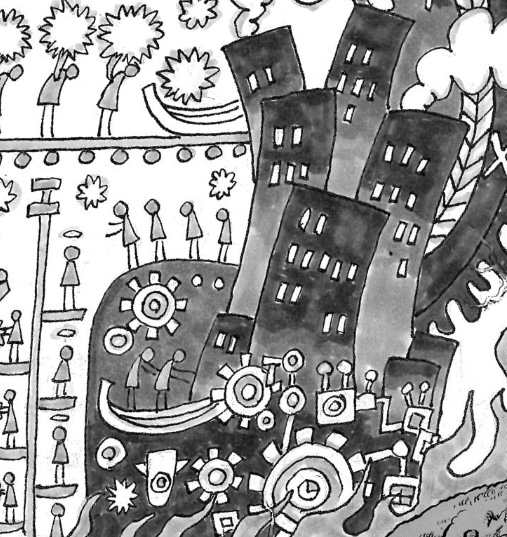
As mentioned above, the elements depicted on the right side of the mural likely represent the advanced scientific power of the “Great Kingdom.”
The various ships shown there may be closely tied to the Ancient Weapons.
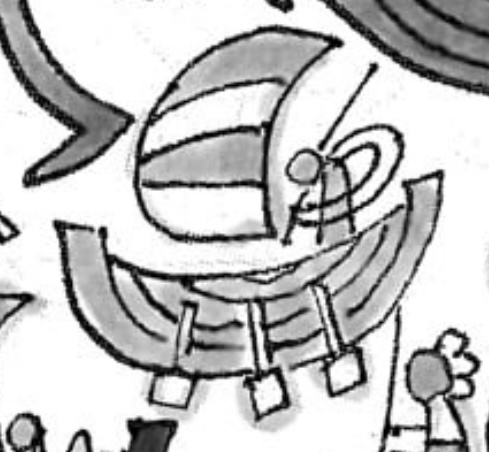
As for Noah, its form—along with the presence of paired animals—may draw from the legend of Noah’s Ark (though the angel-like figure remains unclear).
The king depicted above it could be the one who will “guide correctly.”
Maxim was the flying ark created by Enel, who hails from the sky island known as Birka.
The lightning being unleashed may represent his technique “Mamaragan (Ten Million Volts)”.
This could hint at Enel’s return and involvement in the coming conflict.
The ship with the crowned king standing at its bow is likely the Ancient Weapon Uranus.
This is because it appears to be closely tied to what could be “ancient energy.”
It almost looks as if that energy is being loaded or harnessed within it.
And finally, the one believed to be the Ancient Weapon Pluton…
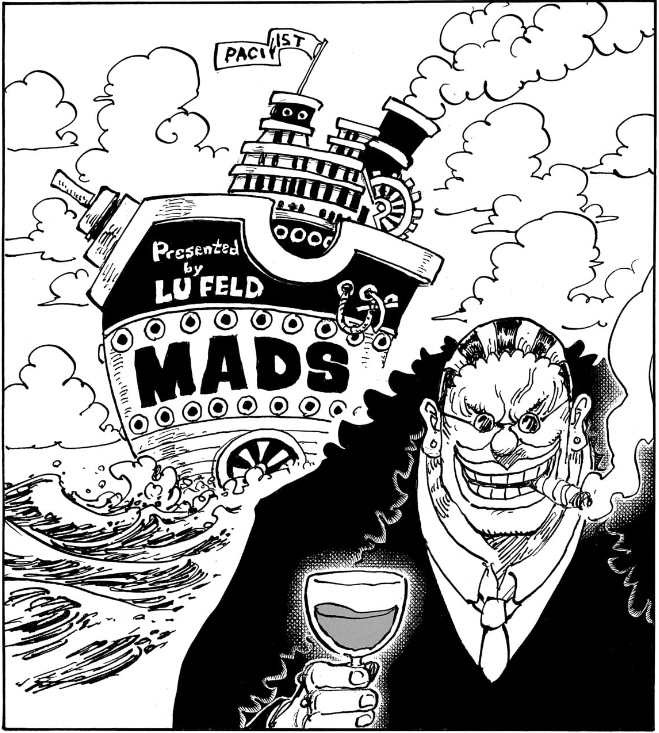
I believe that structure is actually a ship.
To me, it resembles something like the Peace Research Institute MADS.
More importantly, it’s surrounded by other ships, which reinforces the idea that it too is some kind of vessel—not a factory.
What really stands out to me, though, is what appears to be a creature emerging from it—something resembling a dragon or a serpent.
The question is: what does that represent?
- Dragon = Momonosuke (Artificial Devil Fruit)
- Serpent = The Red Line (The Blood-Stained Serpent)
Pluton is sealed deep beneath Wano Country, and Momonosuke, as its shogun, will play a crucial role in its release.
I believe it may function as a weapon capable of piercing through the Red Line.
Based on these two points, this is the conclusion I’ve arrived at.
I believe the Ancient Weapons are indispensable to the “great war.”
If that’s the case, it’s hard to imagine that they would not be depicted in the mural at all.
Dragons and Serpents
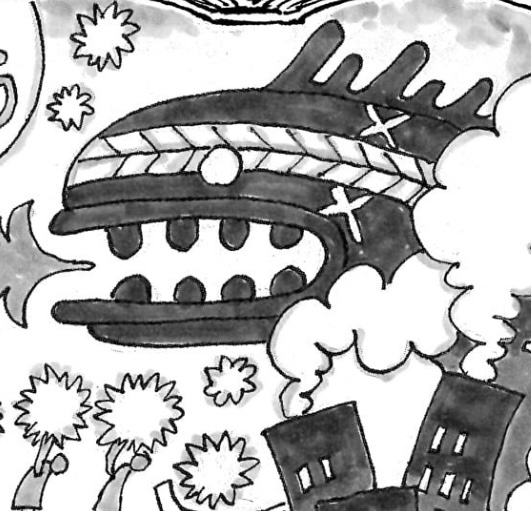
Dragon (Momonosuke)
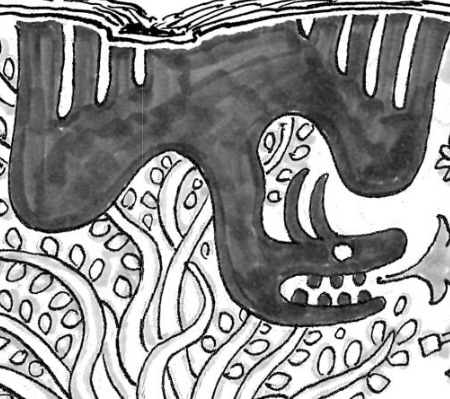
Serpent (Loki)
As mentioned earlier, if we interpret the figure on the far right of the mural as a dragon, then it likely represents Momonosuke.
As Yamato stated, he too is one who will “lead the world to its dawn,” making him an essential figure that cannot be left out—even though samurai are already depicted on the left side.
And then there is the creature emerging from the upper center of the mural…
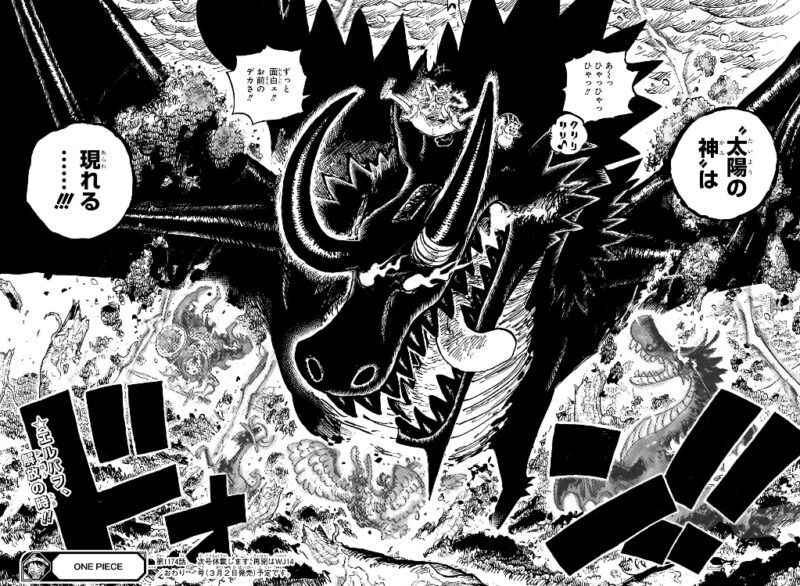
This likely represents Loki’s ability, which was revealed in Chapter 1174—
suggesting that it may indeed be a dragon.
It appears to be none other than the “giant beast that covers the sky,” as described by Yalul.
This certainly raises expectations for Loki’s role in the “great war.”
At first glance, it looks as though the dragon and the serpent are breathing fire at each other, as if they are in conflict.
But depending on how you interpret it, their flames also seem to merge into one.
Perhaps they are actually combining their力量—fighting together rather than against each other.
Conclusion
n this article, we explored what is depicted in the mural preserved in Elbaf.
At the center of it all is the idea of a “great war that will engulf the entire world.”
On the left, we see those led by the Sun God challenging the demon (the World Government).
On the right, there are elements of advanced science and technology, as well as ships connected to the moon—including what appear to be the three Ancient Weapons.
And at the center stands a massive tree, representing the stage of the battle—the very center of the world.
Then there is its connection to the Harley (Sacred Text).
I believe the mural represents a fragment of the story of the “Third World,”
and ultimately reflects the dream envisioned by the people of the moon.
Comments